Fumbling towards catastrophe
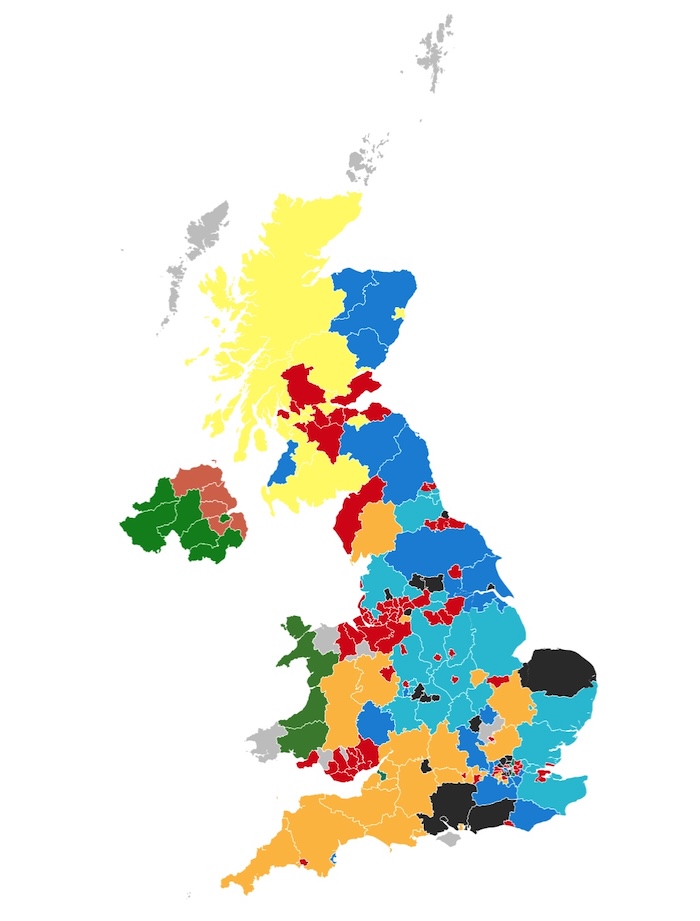
Last week local elections were held in the UK, mainly for district and unitary authority councils in England but also for the Welsh and Scottish parliaments. For the second time, Reform UK gained majorities on a number of county councils as well as several large metropolitan boroughs in Yorkshire and the West Midlands. Last year, they gained majorities on a number of county and large unitary authorities in the Midlands: Lincolnshire, Nottinghamshire, Derbyshire and both halves of Northamptonshire as well as Kent, Lancashire and the metropolitan borough of Doncaster in South Yorkshire. This time they gained Suffolk and Essex counties (both formerly Tory), two met boroughs in the West Midlands and, crucially for Labour, three more met boroughs in South and West Yorkshire: Kirklees (Huddersfield), Calderdale (Halifax) and Wakefield. The map on the right shows the county and metropolitan boroughs according to current dominant party, and the turquoise areas show Reform UK held councils. Labour have been scoring poorly in opinion polls ever since 2024, when they won with a lot of help from a right-wing vote divided between the Tories and the rapidly growing Reform UK, formerly the Brexit Party led by Nigel Farage who was formerly the leader of UKIP. As a result, there have been a lot of calls for the prime minister and Labour leader, Keir Starmer, to resign. Starmer’s supporters are variously calling it idiocy or madness, comparing it to “changing pilots in mid flight”, and pointing to everything Starmer’s government has done for us.
It’s true that on previous occasions when a governing party has suffered local election losses, they have neither changed leaders nor called a general election: John Major in 1995 and Tony Blair in the first term of his government have been mentioned. However, both of these had won majorities on the basis of more than 40% of the vote; Starmer won 2024 on the basis of less than 34%, a smaller share than Blair won in his last election, in 2005, or Jeremy Corbyn’s share in 2017. (John Major’s government, which was losing safe seat after safe seat in parliamentary by-elections, went down to defeat two years after those council elections.) Starmer won seats that Labour had never won before, including in their 1997 landslide; as with some of those seats, these are unlikely to be won again and the winning candidate won less than 30% of the popular vote and benefited from a split Tory vote. For much of the time since, Labour has been polling around 20%. While opinion polls have their flaws, it’s unheard of for a governing party to show this poorly, or anything like it, consistently over months or more than a year. Mid-term blues are a thing, but they are never this bad for a newly elected government which should be riding high. Council elections are not referendums or votes of confidence on the government, but voters often treat them as such.
As the resignations mounted earlier today, someone on BlueSky mentioned by way of a historical parallel a challenge to Gordon Brown’s leadership in June 2009, supported by three ministers (James Purnell, Hazel Blears and Jacqui Smith). In fact, the two women had resigned for reasons connected with their expenses. None of the three, they point out, are still in Parliament: one is in the Lords, one has retired and one is now a CEO of a company. Yet Gordon Brown lost the election the following year, so it does not really strengthen their case for Starmer remaining leader.
These results, in other words, are dire. Labour’s leaders should be painfully aware of the ephemeral nature of the 2024 result and some of the particular constituency results, that Labour won by the skin of its teeth, but it seems they are not. They should be worried about the flipping of former safe Tory county councils to Reform, because it points to the end of the split Tory vote that Starmer benefited from; they should worry about the fact that people are undeterred by the Council Tax rises and other broken promises, poor attendance, recurrent resignations and defections at Reform councils since last year; can we really assume that the immediate resignations this year, or the revelation that one of their winning candidates was a made-up name and an AI-generated picture, will put people off in future? I see his supporters flattering him on social media, appearing blind to his faults as Corbyn’s fans back in the 2010s were to his. They also keep sharing lists of Labour’s achievements since returning to power. These are mostly good things, but in politics “if you’re explaining, you’re losing”. People should not need to have the benefits of a Labour government explained to them; they should be able to feel it, otherwise it will be like the benefits of the EU: we will miss them when they are gone and it is too late. So, stop praising Starmer’s “steady hand” and “boring” or “unflashy” policies. This is not the time for that. People have to know about what they are doing, and feel the benefits.
The country is in dire danger. A party of incompetents and racists is growing rapidly, gaining control of councils from both Labour and the Tories that were considered safe ten years ago, exploiting the failures of both of those parties. Labour have neglected its working-class base for decades, treating them by turns as an embarrassment and as having nowhere else to go. It treats other people’s lives as just bargaining chips, things to calculate over, though these are millions of people and millions of votes. Disabled people, immigrants and their British families, the white working class, the Asian working class. They have just alienated too many major groups for their current strategies to stand a chance of winning another election. I once read a description of the last native prince of Wales, Llywelyn ap Gruffudd (Griffith), that he “simply fumbled his way to disaster” and this, as Jess Phillips’s letter shows, describes aspects of Starmer’s leadership. I am not convinced a new leader will change much; whoever wins will probably be much like Starmer in terms of policy, maintaining the attacks on disabled people’s welfare supports and harsh, unfair changes to immigration law, the attachment to Israel while it wages war on its neighbours and continues the genocide of Palestinian natives, but they might just be able to connect with people in a way Starmer cannot (experience in the US shows the danger of that); what the party needs is not just new leadership but new ideas, fast, to prevent a defeat in 2029 that will make 1983 and 2019 look mild (not least because the winning party was nowhere near as extreme) and allow the wretched Farage to drag this country into the abyss.
Image source: Open Council Data.

