What price Farage’s security?
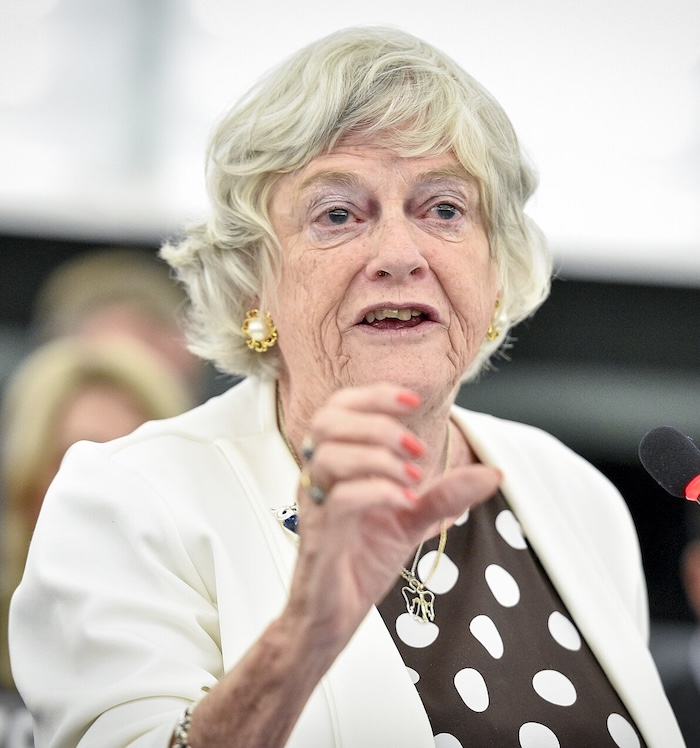
Last week, following the murder or assassination of the former Tory, later Reform UK, politician Ann Widdecombe (right) the week before, the Reform party started making demands that the public purse should pay for their security. I even heard a representative tell a Radio 4 interview that their politicians were under particular threat because they address issues of particular sensitivity and importance, namely immigration and asylum. Widdecombe’s suspected murderer, who was arrested in Rotherham, 250 miles away from the scene, is still being interviewed by the police and has not been charged with anything, though police released some information that said they believed it was politically motivated, though not what the alleged motive was, and that she was targeted specifically rather than at random. Widdecombe was last an MP in 2010; she had also been a Brexit Party MEP during their last term before we left the EU in 2020, and following that party’s relaunch as Reform UK, she had been their immigration spokesperson. She was also well-known for appearances on TV dancing shows and in pantomime and lived alone in a village in the Dartmoor national park in Devon.
Politicians often complain of verbal abuse directed at them by members of the public, especially since it became easy to email or tweet to an MP, but there have not been many assassinations of politicians in the UK; only nine in the UK’s history and none between 1922 (Henry Wilson) and 1979 (Airey Neave). There have been two since 2016: Joanne Cox in 2016, shortly before the Brexit referendum, and David Amess in 2021. Between Spencer Perceval in 1812 (the only assassination of a prime minister) and Jo Cox in 2016, all the assassinations were by Irish Republicans. The PM, Home Secretary and Defence Secretary all get state-funded security and armed bodyguards; other ministers may get security guards at their request or a security advisor’s advice, and since Amess’s murder (and an attempt on the life of the Labour MP Stephen Timms in the 2000s), MPs are offered security guards at constituency surgeries. Ordinary MPs are not usually offered bodyguards or other conspicuous security unless there is a demonstrable threat to their safety and Nigel Farage has never been part of any government, only an opposition MP, and his continued status as an MP depends on winning the by-election that has been called in Clacton, which despite a boycott by all the mainstream parties, he is not certain to win.
Since Cox’s murder in 2016, there has been a trend towards demanding that the general public be kinder to MPs and to remember that they are human too. Recent examples are this piece from the New Statesman and this piece by Gaby Hinsliff in the Guardian, though Brendan Cox (Jo Cox’s widower) has been banging this drum since his wife’s murder. Both the two articles mention that Reform politicians have contributed more than most to the vituperative tone of modern politics while demanding security for MPs that would cost the public purse billions if applied to all MPs. Yet they fail to appreciate that the tone of politics has an impact on everyone else, and that politicians and the media have used ordinary members of the public as scapegoats or hate targets, in particular portraying disabled people as scroungers or idlers, legal immigrants as illegal until proven otherwise (as with the Windrush affair) and immigrants in general (and anyone perceived to be immigrants) as thieves, thugs and rapists. Politicians make decisions that affect everyone, and can cause people to lose their jobs, or be expelled from the country despite it being their home, or to be deprived of healthcare, or to be criminalised for speech or protest, or to have to deal with rampant crime or sexual abuse because the authorities turn a blind eye or are not funded to tackle these problems. Politicians will often call these decisions ‘difficult’, but the difficulty is not borne by them. If they want us to remember that they are human, they might like to remember that we are also human beings, not pieces on a game board.
In some circumstances it is quite right that politicians or other officials receive state protection. One is during a civil war or a terrorist campaign; another is when there are professional criminals who would kill anyone who challenged them in any way; a good example is the Italian mafia which assassinated the judge Giovanni Falcone whose “Maxi Trial” had put hundreds of gangsters in prison in 1992, 19 of them for life, as well as another long-standing anti-mafia investigative judge, Paolo Borsellino. Nigel Farage belongs to neither of these categories; he is just a divisive, rabble-rousing politician. Maybe he wants the state protection because he really does feel endangered; maybe he wants it because it would make him look more important, and that isn’t a good use of public money. Generally speaking, politicians’ safety should be ensured by their own behaviour: a good leader, it has been said, does not fear the hand of his (or her) assassin. Some assassins or would-be assassins are just extremist, as with Thomas Mair and Ali Harbi Ali (the murderers of Jo Cox and David Amess respectively), but in other cases they are provoked by oppression, impoverishment or violence stoked by the politician’s own policies and behaviour. A politician who does not ensure the safety or quality of life of his constituents or those he rules does not have the right to expect those same people to pay for his security, and if he stokes hatred and violence, he has only himself to blame if he falls victim to it himself.
Image © European Union 2019, European Parliament, via Wikimedia.
